
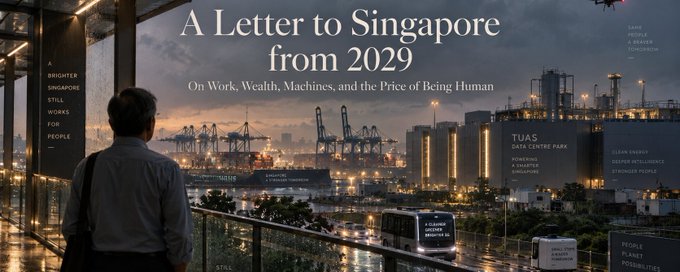
A Letter to Singapore from 2029 On AI Anxiety, Work, Wealth, Machines, and the Price of Being Human

It was raining again in Singapore that Mid-Autumn Festival.
The weather had rolled in from the Strait, and by the time the clouds reached Tuas, the sky seemed low enough to touch the windowless data centres below. Ka Meng stood in a glass corridor watching rain slide down the panes. A few driverless logistics vehicles followed painted lines into the loading bay. A four-legged inspection robot stopped in front of a puddle, hesitated like a dog reluctant to wet its paws, quietly recalculated, and went around it. Farther away, automated cranes continued moving containers through the rain at the port. Every now and then, a red light crossed the dark sky. It could have been a police drone. It could just as easily have belonged to the power company.
A Letter to Singapore from 2029 : On AI Anxiety, Work, Wealth, Machines, and the Price of Being Human
I. By 2029, People Had Mostly Stopped Talking About AI
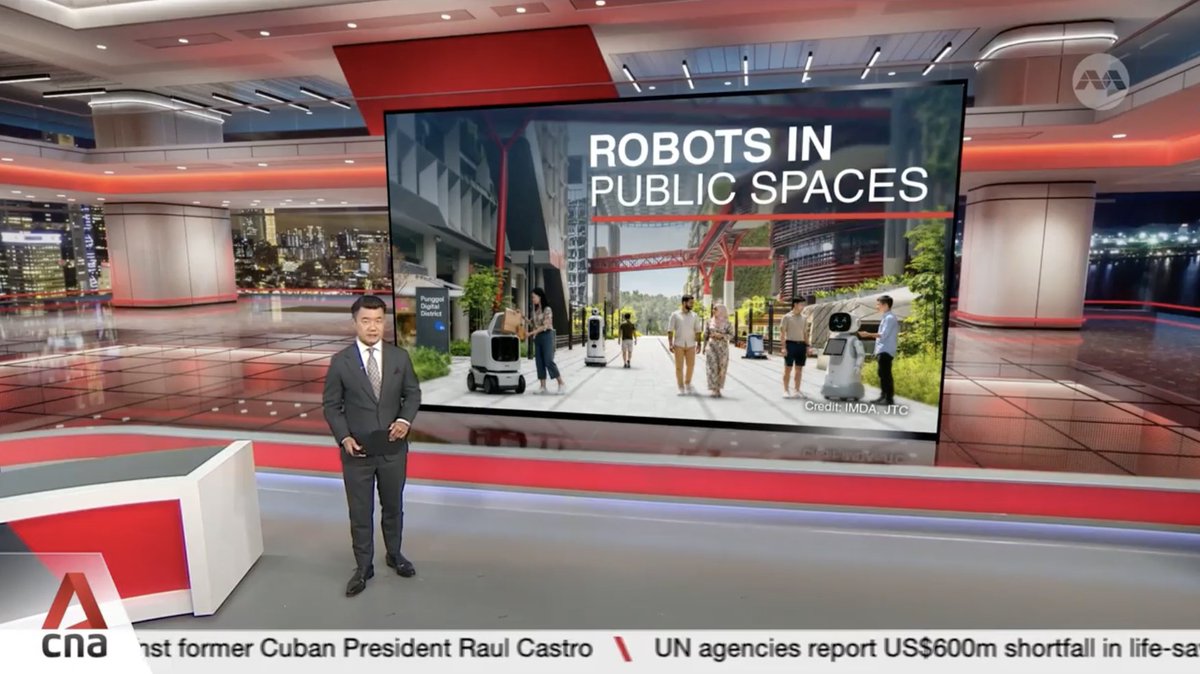
Nobody took out a phone to photograph any of it anymore. Three years earlier, when Punggol first let ordinary passengers ride autonomous shuttles, parents had brought their children just to experience it. The bus would arrive and everyone would take a photo before boarding. By 2029, a vehicle could drive past Ka Meng without anyone inside and attract about as much attention as an automatic door opening.
That is what happens to technologies that truly enter everyday life. They stop looking like the future. Electric light was once a miracle; eventually, all people said was, “Why hasn’t the bulb been fixed?” The internet once felt like another world; later it became the unconscious flick of a thumb inside a lift. AI was heading the same way. The day people stopped talking about “AI” all the time was probably the day it had finally won.
Ka Meng was now in his early fifties, with noticeably more grey in his hair. He still worked at the same regional insurance group, although it no longer resembled the company he had known three years earlier. Revenue was up by almost a third. There were more customers, more products, more markets and more complicated systems. Headcount, however, had not risen at anything close to the same pace. Part of the customer-service floor was empty. Traditional operations teams were smaller. Graduate intake for junior programmers had been squeezed. Meanwhile, terms that had once existed mainly in consulting slides—AI governance, cybersecurity, robotics risk, model assurance—had turned into actual departments with budgets, bosses and KPIs.
His old colleague Ing Khong worked in the data centre below. A few years earlier he had been a programme manager at the insurance company. Then he was retrenched. Now he coordinated automation equipment, infrastructure projects and contractors. Ka Meng’s daughter, Yi Ning, had joined an energy systems company and was working on data-centre loads and grid dispatch. His son, Hou Zai, no longer bothered putting “proficient in AI” near the top of a university application. It would have sounded about as impressive as saying he knew how to use Google.
If you looked only at the streets, 2029 did not look radically different from 2026. The MRT was still crowded. Housing was still expensive. Parents still worried that their children would fall behind. Young people are still worried about jobs. Old people still complained that the world was moving too fast.
But whenever Ka Meng stacked those three years on top of one another, he could see that society had quietly changed its price list. Some things that had once commanded a premium were becoming cheap. Some abilities nobody used to think about had become bottlenecks. Skills a person had spent twenty years perfecting could suddenly become ordinary.
He often found himself thinking about the afternoon when he first noticed it. Turn the calendar back three years. It was September.
It was raining then too.
II. The Rainy Afternoon Ka Meng Cancelled the House Viewing
It was after six in the evening when Ka Meng sat alone in a conference room on the twenty-eighth floor of a Raffles Place office tower. In front of him was a fourteen-page budget. The meeting had ended. Before leaving, the CFO had turned to the final page and circled one line in pen:
If productivity gains are structural, why is headcount still structural?
Ka Meng was forty-six then, the chief operating officer of a regional insurer and one of the senior executives who had pushed hardest for AI adoption. He was not a technological utopian. The company had not adopted AI because anyone wanted to change civilisation. Customer-service queues were too long. Claims were too expensive to process. IT development was too slow.
At first, AI helped employees write emails, summarise meetings and read PDFs. Then it began reading policies, checking claims documents and flagging suspicious transactions. Coding agents came next: taking tickets, reading repositories, fixing bugs and running tests. A complaint that once forced a service officer to move across several internal systems could now arrive with years of policies, payments, claims and complaints already assembled into a single brief for a human to review.
At first, employees were happy. The repetitive, tedious work that nobody enjoyed but everybody had to do began to disappear. Management was happy too. Customers did not have to wait as long. For a while, the most repeated line inside the company was that AI was not here to replace people; it was here to free them to do more valuable work.
The line was not a lie. The problem came later.
Once a tool genuinely makes people more productive, somebody in Finance eventually measures it. A department that used to require eighteen people could now do the same volume with twelve employees and AI. If business demand grew by 40 per cent the next year, there would be no problem. But if demand was forecast to grow by seven while capacity had risen by thirty, what happened to the remaining twenty-three?
You did not need AGI to answer that question.
Excel was enough.
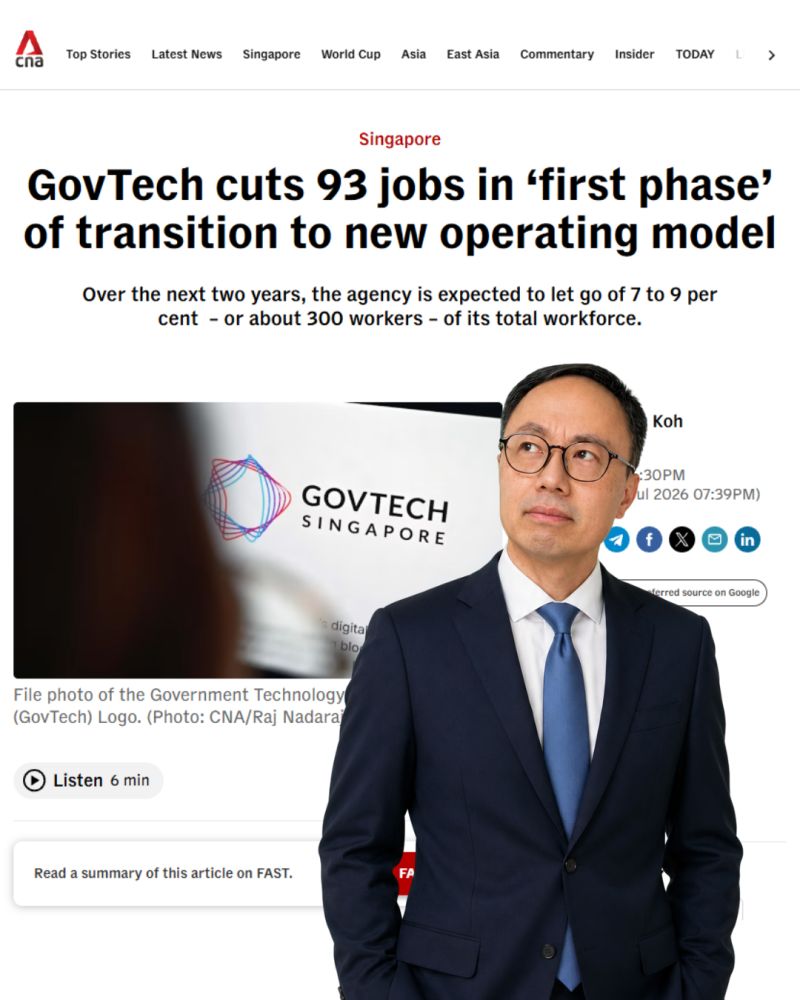
While Ka Meng was looking at those numbers, a news alert appeared on his phone. GovTech was cutting 93 jobs. Around 3,900 people worked at the agency. In the first phase of its restructuring, 305 roles were affected: 102 employees stayed in place, 110 entered retraining or redeployment, and 93 left.
What made Ka Meng pause was not the number 93. GovTech was not collapsing. It was still hiring. What was changing was the shape of the organisation: away from project and vendor management and towards longer-term ownership of products, software, data, engineering and cybersecurity.
After reading the article, Ka Meng began to think that the argument over whether something counted as an “AI layoff” was missing the point. GovTech had not disappeared. Singpass had not disappeared. Demand for government software had not disappeared. There might even be more work in the future.
It simply did not need exactly the same people, performing exactly the same functions, in exactly the same way.
An industry can thrive while someone who has spent twenty years inside it suddenly loses his place. In some ways, that is more unsettling than an industry dying altogether. If the ship sinks, you can blame the storm. If the ship is moving faster than ever but no longer has a seat for you, eventually you start wondering whether you were simply too slow.
That evening, Ka Meng returned home to find Hui Ling cutting papaya in the kitchen. They had planned to view a three-bedroom condo in Upper Thomson on Saturday. They had been looking for months. They had run the CPF numbers, asked the bank about the mortgage, and Hui Ling had already saved pictures of how she wanted the living room to look.
“Still going on Saturday?” she asked.
Ka Meng stood there for a moment.
“Maybe not yet.”
She assumed it was interest rates. He shook his head.
“Not the interest rate.”
She looked at him and did not ask again. After more than twenty years of marriage, there are things that do not need to be finished aloud.
Nobody had retrenched Ka Meng.
Ka Meng had already become afraid to buy a house.
Economists have a term for what came next: precautionary saving. When households become less certain about future income, they hold back spending today. For one family, that is perfectly rational. If a hundred thousand families do it at the same time, individual prudence begins to look like a recession. A condo viewing is cancelled. A car gets driven for another three years. Ten days in Hokkaido become five, then perhaps no trip at all. The refrigerator still works, so the strange noise it makes at night can wait.
The first economic impact of AI may not show up in the unemployment rate. It may show up in a Saturday house viewing that never happened, because people do not spend only the salary they receive today. They also spend against their belief that a salary will still arrive tomorrow.
AI first disturbed that belief.
III. The Year the Mooncakes Came Without Egg Yolks
When Mid-Autumn arrived, the company still gave out mooncakes.
In previous years it had been reduced-sugar double-yolk lotus-paste mooncakes from Raffles Hotel, packed in boxes that looked more suitable for jewellery. When Hou Zai was small, he liked watching Ka Meng cut one cleanly down the centre to see whether the two salted egg yolks landed neatly on opposite sides.
That year, there were four ordinary low-sugar white-lotus mooncakes in the box.
No yolks.
Someone in the company Whatsapp group chat wrote that the AI transformation had apparently transformed the egg yolks away as well. A row of laughing emojis appeared. Then everyone went back to work.
Ka Meng knew the missing yolks and the headcount-adjustment spreadsheet belonged to the same story. The company was not poor. In fact, profits would later improve. What had changed was the value system underneath the budget. What was still worth paying for? What was no longer worth paying for? If work that once required ten people could now be done by six, was it still worth ten salaries?
Ing Khong’s name appeared in the first batch.
He was fifty, a programme manager who had worked with Ka Meng for eight years. He was not bad at his job. He was exceptionally useful. His value came from knowing why large organisations almost never behaved like their process charts. Which vendor saying “no problem” on a Friday afternoon usually meant there was a very serious problem. Which department would agree to everything in the meeting and then do nothing afterward. Which field in an old system looked harmless but sat on top of a decade of legacy logic that nobody dared touch.

People used to call this experience, and experience was valuable because nobody else could simply take it from you.
Then meetings were recorded automatically. Project histories became searchable. Models could read emails, vendor submissions and old documentation. Risk could be recalculated overnight. AI did not suddenly acquire Ing Khong’s twenty years of human intuition, but the company could now move part of what had once lived only inside one man’s head into systems accessible to everyone.
Ing Khong had not become less intelligent.
He had become less scarce.
Ka Meng spoke to him personally. HR went through the severance package, notice period and career-transition support. Ing Khong did not become angry. At the end, he only asked, “Did I do something wrong?”
“No.”
“Then why me?”
Ka Meng was silent for a few seconds.
“The skill set we need is changing.”
He would remember that line for years. A man could work hard inside one world for twenty years, commit no great mistake and shirk no responsibility, only to be told one day that the exam he had spent his life preparing for had been cancelled.
Companies do not need cruel bosses for this to happen. Competition is enough. If Ka Meng refused to reduce headcount while a competitor used 20 per cent fewer people to deliver the same product, that competitor would enjoy lower costs. It could cut prices, pay higher commissions and spend more on marketing. A few years later the board would ask why competitors had converted AI productivity into margin while they had not.
If Ka Meng refused long enough, Ka Meng might be the first to leave.
The next CEO would probably make the same decision.
There is a peculiar cruelty in modern capitalism that comes precisely from how impersonal it can be. Nobody has to hate you. You do not even have to do anything wrong.
Efficiency is enough.
During his first week of unemployment, Ing Khong applied only for jobs paying roughly what he had earned before. By the second month, he was willing to take 15 per cent less. By the third, 25 per cent less was negotiable. At two in the morning he would scroll LinkedIn and look at former colleagues getting promoted. At three, he would open his banking app and calculate how many years remained on the mortgage.
Savings stopped being money.
They became time.
Fourteen months. Twelve. Ten.
Someone with a job often feels that time moves too quickly. Someone unemployed for long enough can discover the opposite. We say that work is about earning a living, but work also organises time, identity and dignity. If someone needs you every Monday morning, you know why you are waking up.
When work disappears, a person does not lose only income. He loses a small piece of evidence that says: there is still a place for me in this world.
IV. It Went Into Someone Else’s Future
After Ing Khong left, the company’s financial statements became prettier. Labour costs fell. Claims moved faster. IT delivery improved. Operating margins widened. The share price went up.
Ka Meng owned company stock.
His net worth went up too.
For the first time, he felt the moral ambiguity of the AI economy in a very personal way: he had signed off on the disappearance of people’s jobs, and because those jobs disappeared, he became wealthier.
One evening, he spread the annual report across the desk at home and traced a line with a pencil.
Where does a salary go when it disappears?
Money does not evaporate. Lower payroll becomes, in part, higher profit. Some profit flows to shareholders. Some becomes capital expenditure. That capex buys models, cloud services, servers and networking equipment. Cloud companies take the money and buy GPUs. Behind GPUs sit HBM, wafers, advanced packaging and semiconductor equipment. Data centres then buy land, cooling capacity, electricity and new generation.
The old hundred dollars might once have travelled like this: company to wages, wages to household, household to mortgage, restaurant, holiday, car or refrigerator.
Increasingly, some of that hundred dollars began travelling a different road: company to profit, profit to capex, capex to GPUs, chips, data centres, grids, power plants and assets.

Both paths count toward GDP, but they move through society differently. Give money to a hundred employees and you create a hundred sets of household decisions. Give the same money to a few shareholders and a capex committee and you create a different economy.
That is how a country can eventually produce a world that seems contradictory. The stock market can be doing well. GDP can be growing. AI capex can be booming. Semiconductor and power projects can be full of activity. And yet many households can sincerely feel as if they are living through a recession.
GDP is not lying.
Neither are the households.
They are simply living in different denominators of the same number.
The Industrial Revolution produced a similar fracture. Economic historian Robert Allen used the idea of the Engels’ Pause to describe a period when productivity and profits advanced while real wages failed to rise alongside them. Machines increased society’s ability to produce, but production capacity does not automatically transform itself into purchasing power distributed across households.
Acemoglu and Restrepo later described two forces that help explain the same tension. Automation creates a displacement effect, taking tasks once performed by labour. At the same time, technology can generate new tasks and complementary activities that bring human beings back into the production process—the reinstatement effect.
Both can occur. The difficulty is the time between them.
Countries can wait. Statistics can wait. People often cannot.
Ing Khong’s mortgage arrived every month.
One of the cruellest tricks of economic history is its ability to compress decades of human pain into a sentence like:
Labour was eventually reallocated.
V. When Four Economic Clocks Were Ticking at Once
In the fourth month of Ing Khong’s unemployment, Ka Meng attended a closed-door economic forum. A professor drew four concentric circles on a whiteboard and said that the AI economy could not be understood by asking whether “the economy” was doing well or badly. There was no single economic clock.
The innermost clock was the Kitchin cycle, roughly three to five years, often associated with inventories and short business fluctuations. Ka Meng stopped looking at condos. Ing Khong delayed replacing his refrigerator. More households cancelled trips. Retailers saw goods moving more slowly and cut inventory. Suppliers received fewer orders. Inside this clock, the economy could feel decidedly cold.
Outside it sat the Juglar cycle, roughly seven to eleven years, associated with equipment and fixed business investment. A household could decide not to replace a refrigerator without Amazon, Microsoft, Google, Meta or an AI laboratory deciding to stop buying GPUs. If anything, fear of falling behind could make companies invest more aggressively in servers, machines and compute.
Beyond that sat the Kuznets swing. Stretch the time horizon to a decade or two and the constraints begin to change. The question is no longer only whether there are enough servers. It becomes whether there is enough electricity, land, semiconductor capacity, cooling, grid infrastructure and copper. That is when new power plants, transmission infrastructure, data centres and industrial facilities begin to appear.
The outermost circle was the Kondratiev wave. Over decades, what transforms society is not a particular product but a general-purpose technology that rearranges the price structure of the economy. Steam changed the cost of distance. Electricity changed the cost of usable energy. The internet changed the cost of information.
AI was beginning to change the price of cognition and execution.
The four clocks did not need to move in the same direction. A banker in the CBD could feel as if he were living through a recession while an engineer in Tuas had more projects than he could handle. Households could be saving while corporate capex surged. Office headcount could fall at the same time data centres and factories were hiring.
They were not contradictory stories.
Different people were simply living inside different cycles.
Carlota Perez’s framework added a longer arc. Technological revolutions often begin with an installation period: capital rushes in, infrastructure is built, early winners accumulate wealth and older skills and organisations are broken apart. Then comes a turning point, when technology moves faster than institutions, education, income distribution and human adaptation can manage. Only if those systems eventually reconnect can society enter a broader deployment period.
This was why Ka Meng eventually came to believe that the frightening thing about AI might not be that models were becoming too intelligent.
It was that different parts of society lived on different clocks.
A model could change in six months. A university degree took four years. A forty-nine-year-old might need two years to retrain. A power plant took far longer. An education system changed more slowly still. A generation might take a decade to change its idea of what counted as a respectable profession.
Machine time was accelerating.
Human life could not be accelerated with it.
VI. The Lighter the Intelligence, the Heavier the World
As money shifted from wages toward capital expenditure, the lights in western Singapore seemed to grow brighter.
On a screen, AI looked weightless: a prompt, a chat box, a model somewhere in “the cloud”. The first time Ka Meng walked through a major data centre, he understood that the cloud was really just someone else’s factory.
The halls were cold and loud. Racks stretched down the room. Cables as thick as an arm ran overhead. Cooling systems never stopped moving.
Artificial intelligence still had to pass through copper and fibre, through silicon wafers, HBM and advanced packaging, through transformers, natural gas, cooling water and power grids. It still depended on someone receiving a call at three in the morning and coming back to fix a pump.
The lighter intelligence became, the heavier the world supporting it became.
For three decades, the ideal company had been imagined as something increasingly detached from physical reality: asset-light software, platforms and cloud services, with factories, inventories, land and energy outsourced to someone else.
AI pushed that logic so far that the world began to curve back on itself.
The bottlenecks returned to electricity, land, factories, equipment and physical systems.
That is why white-collar displacement and industrial expansion could happen at the same time. AI might reduce demand for some programmers while increasing demand for chips. Chips required more equipment and fabs. Data centres required more power. Power required grids, generation, engineering and maintenance.
New work would appear.
History simply never promised that the new jobs would materialise neatly at the feet of the people who had lost the old ones.
VII. The Machines Entered the Physical World
For a while after losing his job, Ing Khong seriously considered driving private hire.
The logic felt obvious. If the office was unsafe, go into the physical world. ChatGPT could write reports, but surely it could not grow a pair of legs and step on the accelerator.

Then the autonomous shuttles in Punggol moved from novelty to normality.
People did not need to be technology enthusiasts to accept driverless transport. If the vehicle arrived faster, cost a little less and crashed less often, most passengers were not going to wait fifteen minutes longer and pay several dollars more in order to preserve the occupation of a driver they had never met.
Businesses wanted lower costs. Consumers wanted convenience. Governments wanted safety.
Three separate motives could lead to exactly the same destination.
Robots did not even have to resemble human beings. Warehouse AMRs did not need legs. Industrial arms did not need faces. Drones did not need hands. Autonomous vehicles did not need to look like drivers.
The important labour-market question was never how human the machine looked. It was how many machines one human could supervise.
Ten workers could once move ten loads. Later, one person could watch ten robots do it. Ten security officers might once patrol ten routes; later, a control room could monitor cameras, drones and ground robots together. “Unmanned” rarely meant that no human existed anywhere in the system. More often, it meant one human had been stretched across what used to require ten.
Productivity rose.
Labour demand fell another notch.
Ing Khong eventually decided not to drive Grab. Running from AI into driving, he realised, might not mean escaping automation. It might only mean meeting it a few years later.
So he went into the data-centre industry instead.
He failed his first interview. They asked about PUE, UPS systems, chillers and busbars, and he did not understand enough of it. There was nothing cinematic about returning to a classroom at forty-nine. People fifteen years younger answered faster. Sometimes a lecturer used a term he did not understand and he went home to Google it, while the ITE student next to him was already asking Claude.
He later told Ka Meng that the hardest part was not learning.
It was accepting that he had become someone who did not know.
Much of middle-aged dignity is built around familiarity. Twenty years in a profession gives you more than income. It gives you the comfort of knowing how the world works. The real violence of a career change is being asked, at forty-nine, to surrender that familiarity and admit ignorance again.
Ing Khong eventually found work. His salary was more than 20 per cent lower than before. But after a while, he discovered that his old experience had not vanished completely. He still knew how to manage vendors, read schedules, handle exceptions and recognise when a system should not be trusted.
The difference was that his old projects lived in Jira.
Now a transformer could weigh dozens of tonnes.
The physical world had found a new price for his experience.
VIII. When Answers Stopped Being Valuable
Ka Meng first realised that education would have to change on an ordinary Wednesday evening.
Hou Zai had written an English essay in fifteen minutes. It was good: clear structure, mature argument.
“You wrote this?”
“Yes.”
“Used AI?”
Hou Zai paused.
“A bit.”
“A bit” meant that the AI had first discussed the question with him, asked a few things, proposed three possible structures and let him choose one. After he wrote the draft, the model identified logical gaps. He revised it again.
So whose essay was it?
Schools used to rely on a convenient assumption: the answer a student submitted represented the student’s ability. AI broke the link between answer and ability, and once that happened, education had to decide what it was really supposed to measure.
The AI era might not make education easier.
It might make it more demanding.
Because answers had suddenly become cheap.
For generations, education often asked: Can you calculate this?
The more valuable question was becoming: Do you know what should be calculated in the first place?
One person could tell an AI, “Analyse this company for me,” and receive twenty pages of analysis. Another would begin differently: Am I trying to judge a three-month trade or a ten-year business? Is revenue growth coming from volume or price? Is margin improvement driven by product mix or accounting? What happens if the largest customer cuts orders? What evidence would force me to admit my thesis is wrong?
The same AI in two hands could be like the same knife in the hands of two different chefs.
As machine capability became more evenly distributed, what became visible was the structure of human cognition: whether someone could turn a vague concern into a precise problem, reason causally, judge evidence, identify the important variables and think in counterfactuals.
That was also why fundamental knowledge did not become less important as AI became stronger.
It became more important.
In the old world, someone with weak knowledge often produced a weak answer. In the new world, that same person might receive an answer written in perfect English, accompanied by beautiful charts and a polished logical structure, while the first assumption underneath it was wrong.
That was more dangerous than ignorance.
Ignorance usually looked like ignorance.
An AI-age mistake could arrive wearing a PHD title.
People would need knowledge not to defeat machines, but to retain the right to reject them.
Taste would become more valuable too. When a machine could generate a hundred images, a hundred songs or a hundred logos in a minute, production itself was no longer scarce. Selection was. Knowing why ninety-nine images should be deleted, why something could be beautiful and still vulgar, why an expensive-looking room could feel wrong, why a sentence could be grammatically perfect and somehow have no human voice—these abilities, once dismissed as soft skills, could become productive capital.
Machines generated possibility.
Humans decided what deserved to remain.
By 2029, Hou Zai’s exams were in some ways harder than his sister’s had been. There were fewer take-home essays and more live thesis defences. Students could use AI, but teachers did not stop at the answer. Why did you ask the question this way? Why do you trust this source? Why did you reject the other solution? What evidence would change your mind?
Once AI made “What is the answer?” too easy, education was forced back toward much older questions.
Why do you believe this?
What gives you the right to make that judgement?
What problem are you actually trying to solve?
Technology had travelled so far forward that education somehow found itself back with Socrates.
IX. When Intelligence Became Cheap, Ownership Became Expensive
AI did deliver a profound form of equality.
A small businessman in Johor Bahru who could never have afforded a permanent lawyer, translator, programmer, advertising team and data analyst could gain a meaningful portion of those capabilities through a handful of agents. An ordinary child could have something approaching an endlessly patient private tutor. An elderly person could ask an AI to read an insurance contract. A three-person company could attempt work that once required dozens.
Cognitive capability was becoming cheap enough to be supplied almost like electricity.
That was real progress.
But equality of capability was not equality of wealth.
Everyone could have access to AI without owning GPUs, data centres, land, customer relationships, brands, intellectual property or equity.
Ka Meng knew a young founder named Ah Kai. His company had only a dozen people. Agents wrote code, handled support, ran advertisements, organised leads and prepared contracts. Revenue was approaching what Ka Meng once associated with a hundred-person software company. After a funding round, Ah Kai’s equity was worth eight figures.
What did he do after becoming rich?
He bought a home. Then he helped his parents move into a better one. Then he bought shares. Then he invested in friends’ companies.
There was nothing particularly cynical about this.
When people lose money, they first protect their survival. When they gain money, they first protect the money. Ideals tend to come after security.
The wealth created by AI would, of course, flow back into society. It would simply take a different route.
In the old company, ten million dollars of additional revenue might pass first through a hundred payslips. In the new company, the same ten million might first pass through fifteen salaries and several lines on a cap table.
The money was still there.
It had simply passed through fewer hands.
The great class divide of the future might therefore stop being about who could use AI.
Everyone could.
The more important divide would be between those who could use AI and those who owned what AI produced.
Technology can democratise capability.
Property does not democratise itself.
X. 0.87 Children and a Political Problem With No Correct Answer
At the same time AI began reducing demand for some forms of labour, Singapore faced another problem that appeared to contradict it.
There were not enough people.

The fertility rate kept falling. The population kept ageing. From a narrow labour perspective, AI and robotics appeared almost perfectly timed. Not enough drivers? Use autonomous vehicles. Warehouses short of workers? Use robots. More elderly people? Build care technology. A limited police force? Give each officer more reach through drones and AI.
But a population is not merely labour input.
A country also needs families, consumers, taxpayers, communities and another generation.
Machines can perform tasks.
They cannot grow a country’s next generation for it.
At the same time, AI, semiconductors, energy and robotics needed the best specialists in the world. That produced an uncomfortable political triangle. A retrenched middle-aged Singaporean could ask, “If I cannot even find a job, why are we still bringing in foreign talent?” A technology company could reply, “Without those people, we move the lab elsewhere.” The manpower planners could then add, “We are not having enough children.”
From where each of them stood, all three statements could be true.
The hardest policy problems are rarely choices between right and wrong. They are choices between several correct answers, with the government deciding who bears the cost first.
Government has incentives too. Stop AI and capital may leave. Let the market run without protection and white-collar anxiety may eventually become opposition votes. Close the door to global talent and the new industries may relocate. Open it without limits and locals may begin asking what exactly the growth has to do with them.
That is why the politics of the AI age would not look very science-fictional. It would look like a collection of administrative programmes: SkillsFuture, wage insurance, career-conversion support, CPF top-ups, childcare assistance, AI transformation grants.
Individually, each might appear small and bureaucratic. Together, they would be trying to answer a question modern industrial society had been able to avoid for two hundred years:
If production needs fewer people, how does income continue reaching people?
Training alone cannot solve the arithmetic.
If a bank once needed one thousand back-office workers and AI reduces the requirement to six hundred, you can make all one thousand “AI-ready”. The bank still needs six hundred.
Training can address a skills mismatch.
It cannot make four hundred missing positions reappear.
At that point AI stops being mainly a technology problem.
It becomes a distribution problem.
XI. The Safer the City Became, the More Eyes It Grew
Ka Meng’s father was seventy-nine when he started using a health assistant.
At first, the old man did not trust it. How could that little MicroDuck thing that looked like Donald Duck know anything about medicine? Then one night he felt tightness in his chest. The system assessed the symptoms and his medical history and told the family not to wait until morning.
They went to the hospital. It turned out to be nothing serious.
After that, he was willing to keep using it.
One day he asked Ka Meng whether the system knew what time he went to sleep.
“Probably.”
“Even what time I go toilet?”
“Probably that too.”
The old man frowned.
“Not very good, leh.”
A little later, he added, “But don’t switch it off. Last time I fell, lucky got this.”
Ka Meng eventually came to think that this was probably how most people would really feel about surveillance in the future.
We do not love being watched.

We are simply frightened by what happens when nobody is watching.
For an elderly person, falling and nobody knowing can feel more frightening than the loss of privacy. For a parent, a missing child can feel more frightening than another camera. Losing a lifetime’s savings to a scam can feel more frightening than a bank examining transactions more aggressively.
Freedom, therefore, is rarely surrendered in one dramatic moment. It is usually divided into small pieces and exchanged for specific benefits. A few more cameras for a little less crime. More financial monitoring for fewer scams. More road data for fewer accidents. More school surveillance for parents who sleep a little better at night.
Every exchange can be individually reasonable.
Eventually, society looks different.
And the larger change is not simply that cameras become more common.
The cameras begin to understand.
In the old system, cameras recorded and humans searched the footage after something happened. Later, AI could identify unusual running, fighting, abandoned objects, suspicious vehicle movements or behavioural anomalies, then pass the few relevant cases to a person.
At first, the promise would be human-in-the-loop: the machine recommends, the human decides.
But if the system is correct ninety-nine times out of a hundred, while one human reviewer must process eight hundred cases a day, the human begins to change too.
People start trusting the system.
Human-in-the-loop gradually becomes human-on-the-loop. The machine handles routine cases. The human handles exceptions. Efficiency improves. Consistency may improve. Fairness may improve.
But the grey zone shrinks.
Ka Meng once received a traffic notice containing his speed, position, signal timing and video. There had been no officer standing at the road and no argument afterward. His first reaction was that it was fair.
His second was that it was damn irritating.
The greatest strength of machine enforcement and its least human quality were the same thing:
It did not care who you were.
An old person crossing the road slowly, a delivery rider stopping for two minutes, a student submitting homework late because something happened at home, a hawker’s stall extending a little past the line—society had never operated only through written rules.
It also operated through something difficult to put into legislation.
See how first.
Give chance lah.
Paiseh.
Never mind lah.
AI could learn exceptions too. But once an exception was formalised into code, it became another rule.
The future city might therefore become safer, more consistent and more transparent. Corruption might fall. Dangerous driving might fall. Fraud might become harder. But the space in which you could simply “talk to someone” would also become smaller.
Max Weber wrote about rationalisation, the process through which modern society becomes increasingly calculable, administrable and predictable. AI could push that process farther than human bureaucracy ever could, because the reason many rules were not perfectly enforced in the past was not necessarily tolerance.
Enforcement was expensive.
A police officer could not stand on every street. Every car could not be checked manually. Every application could not be examined in full.
Once machines reduce the marginal cost of enforcement, society acquires the ability to seriously enforce almost everything it has written down.
For years, people worried that AI might become more like humans.
The stranger possibility was the opposite.
Human society might become more like AI.
XII. By 2029, Ka Meng Finally Understood the Rationale
Looking back from 2029, Ka Meng realised that the professor’s four economic clocks had not been academic abstractions at all. They had landed in different people’s lives.
The short Kitchin clock appeared in the condo that Ka Meng and Hui Ling did not buy, the refrigerator Ing Khong delayed replacing for two years, and the holidays and dinners households cancelled. When white-collar workers first began feeling AI risk, the first thing to rise was not a new industry.
It was savings.
The Juglar clock appeared in corporate AI budgets, cloud servers, robots and automation systems. Households became afraid to spend while firms spent more aggressively in order to lower future operating costs.
The Kuznets clock appeared in data centres, fabs, grids, generators and industrial infrastructure. AI had looked like a software revolution and ended up forcing the world to build more heavy assets.
The Kondratiev wave was slower and deeper. It rearranged the relative price of labour, energy, cognition, land, capital and ownership.
At that point, a future that once sounded impossible began to make sense.
GDP could continue rising. Production could continue expanding. Yet the economy no longer had to increase the number of people participating in production at the same rate. A company of a dozen people could generate revenue that once required a hundred. One engineer could manage several agents and perform work previously assigned to a team. One operator could supervise a fleet of machines.
Production had not disappeared.
People were simply no longer growing at the same rate as output.
In one sense, this should have been the fulfilment of a centuries-old human dream.
Why did humanity invent machines, if not so machines could work for us?
The problem was that over the same two centuries, we had built another system on top of that dream: most people first had to prove that the production system needed their labour before they were allowed to earn income, and then use that income to purchase what the production system produced.
AI was beginning to weaken the first sentence.
The second sentence had not yet changed.
That was the deepest contradiction of the AI age.
When machines work for people, it ought to mean freedom.
In an economy where income still arrives mainly through employment, it first looks like unemployment.
The same technology can be liberation and threat.
The difference is not inside the machine.
It is inside the institution.
This is where Perez’s turning point becomes important. Whether a technological revolution eventually produces broad prosperity does not depend simply on how powerful the technology becomes. It depends on whether society can redesign wealth, employment, education and time around the new productive reality.
2029 was not the ending.
It might only have been the year the question finally became impossible to avoid.
XIII. The Day Ing Khong Finally Bought the Fridge
When Ing Khong received his first decent bonus at the data centre, he did not buy AI stocks.
He paid off his credit-card balance.
Then he went to Best Denki and bought the refrigerator they had postponed replacing for two years (without CDC voucher). His wife spent a long time choosing one. They eventually bought a Japanese model slightly more expensive than the original budget.
A month later, they booked tickets to Hokkaido again.
Consumption returned.
Not because a GDP report said the economy had recovered, but because Ing Khong had started believing that income would still arrive next year.
All complicated macroeconomics eventually lands somewhere very small.
Whether a person is willing to spend today’s money depends on whether he believes in tomorrow.
That Mid-Autumn Festival, Ing Khong came to Ka Meng’s home with a box of mooncakes. When they opened it, all four were double-yolk lotus paste.
Hou Zai laughed. “Uncle, got trauma ah?”
Ing Khong laughed too.
“One year no yolk. After that, see already scared.”
Everyone laughed.
Ka Meng’s father sat nearby. His health assistant reminded him not to eat a second mooncake. He complained that the thing was kaypoh, but he did not switch it off. Hou Zai was in his room debating an assignment with AI; the next day his teacher would ask him why he had rejected two answers proposed by the model. Outside, an autonomous vehicle stopped by the building, a delivery robot waited for the lift, and somewhere in the distance a drone light crossed the sky.
Nobody said the future had arrived.
Because the future does not usually announce itself.
That would be a declaration of war.
The future prefers to seep quietly into daily life until, one day, nobody remembers when the present ended.
XIV. In the End, It Was Never the Machines That Changed the World
Ka Meng gradually came to understand that the most important question about AI might never have been whether machines would develop desires.
Machines did not need desires.
Human beings already had more than enough.
Employers wanted lower costs because they feared competitors. Employees saved more because they feared unemployment. Consumers accepted autonomous vehicles because they wanted lower prices and shorter waits. Parents bought AI tutors because they feared their children falling behind. Young workers moved into semiconductors, energy and robotics because they feared their skills losing value. Elderly people accepted monitoring because they feared falling alone. Governments added cameras because people wanted security. Governments attracted foreign talent because companies feared losing technological races, while subsidising local transitions because governments feared losing votes.
Nobody sat inside a secret room designing the Singapore of 2029.
Everyone simply moved one step toward whatever felt safer and more advantageous from where they stood.
Once millions of people had taken enough of those individually reasonable steps, the offices had fewer people, the factories had more machines, the sky had more drones, the roads had fewer drivers, schools had fewer standard answers, cities had more eyes, energy had become more valuable, judgement and taste had become more valuable, ownership mattered more, and the grey spaces where human beings once said “give chance lah” had become smaller.
That is how technology truly changes the world.
It does not order humanity around.
It changes prices.
Prices change choices.
Choices become institutions.
Institutions eventually become ordinary life.
Another rainy season came. Ka Meng stood outside the data centre in Tuas while thunder rolled in from the Strait. Inside, tens of thousands of chips were working continuously. Some were writing code. Some were reading medical records. Some controlled robots. Some analysed camera feeds. Others were helping humans design the next generation of machines.
Outside, a technician in his twenties crouched beside a cooling-water line. Ing Khong was a short distance away speaking to a vendor. Yi Ning was working a few kilometres away in an energy-control centre. Ka Meng’s father was at home arguing with his medical AI over whether he was allowed another piece of durian.
And Ka Meng suddenly understood that the world had not been taken over by robots.
It had simply been repriced.
The value of an hour of a programmer’s execution, the value of twenty years of organisational memory inside a middle-aged man’s head, the value of a driver’s time behind a steering wheel, the price of a kilowatt-hour, the price of land, the value of judgement, of taste, of human discretion—and even the value of a person’s belief that the next ten years of life would remain stable enough to plan for—all of it had been returned to the market and asked the same question again:
What are you worth now?
He thought about that box of mooncakes from years earlier.
At the time, everyone thought the company had simply removed an egg yolk.
Only later did he realise that it had been the first small corner of a new world showing through.
Industrial revolutions do not begin by changing society directly. Machines first change prices. Prices change choices. Choices change companies. Companies change cities. Cities change politics. Politics eventually returns to decide how the wealth is distributed.
That is probably how the future comes.
Not in a single morning, but as rain on a weekday, a fourteen-page budget, a cancelled house viewing, a graduate who never gets hired, a robot nobody bothers photographing anymore, a child discovering that the correct answer is no longer especially valuable, an old man accepting that a machine knows when he sleeps because he wants someone to know when he falls, and a city slowly translating more and more exceptions into rules.
Then one day, humanity looks back and realises that in trying to avoid every immediate risk and capture every immediate benefit, it has walked step by step into somewhere new.
Ka Meng finally understood that they had been asking the wrong question from the beginning.
The real question was never:
What will AI become?
It was what human beings would choose to keep for themselves once calculation, execution and answers became cheap.
Perhaps judgement. Responsibility. Taste. Relationships. Trust. Ownership. An understanding of the physical world.
Or perhaps something older than all of them: the ability to know why something ought to be done in the first place.
Machines will continue making the How and the What cheaper.
Human beings may eventually have to relearn the Why.
Funny, in a way.
Technology travelled all this distance into the future—only to bring us back to philosophy.